
Signs You Need a Life Coach: 8 Patterns Worth Noticing

What if the clearest signs you need a life coach aren’t one difficult day, but a recurring gap between what matters to you and what you’re able to follow through on? You may want change, set intentions, and still find yourself circling the same decisions. That pattern doesn’t mean you’re failing. It may mean you could use space to pause, find clarity, and choose your next steps with intention.
If you’ve been second-guessing yourself or losing sight of your priorities, it makes sense to wonder whether coaching could help. You don’t need to have everything figured out before asking that question. Life coaching offers collaborative, goal-focused support for personal growth and practical action. It isn’t therapy, diagnosis, or treatment for mental health concerns.
In this article, you’ll explore eight recurring patterns that may make coaching worth considering, how to recognize them without turning them into personal shortcomings, and what coaching can and can’t support. You’ll also get practical questions to help you decide what kind of support fits your goals.
Table of Contents
What Signs You Need a Life Coach Might Notice in Everyday Life
Noticing a pattern is an invitation to reflect, not proof that you’ve failed. Everyone faces uncertainty, delay, or change. The useful question is whether the same difficulty keeps returning and getting in the way of a goal you chose for yourself.
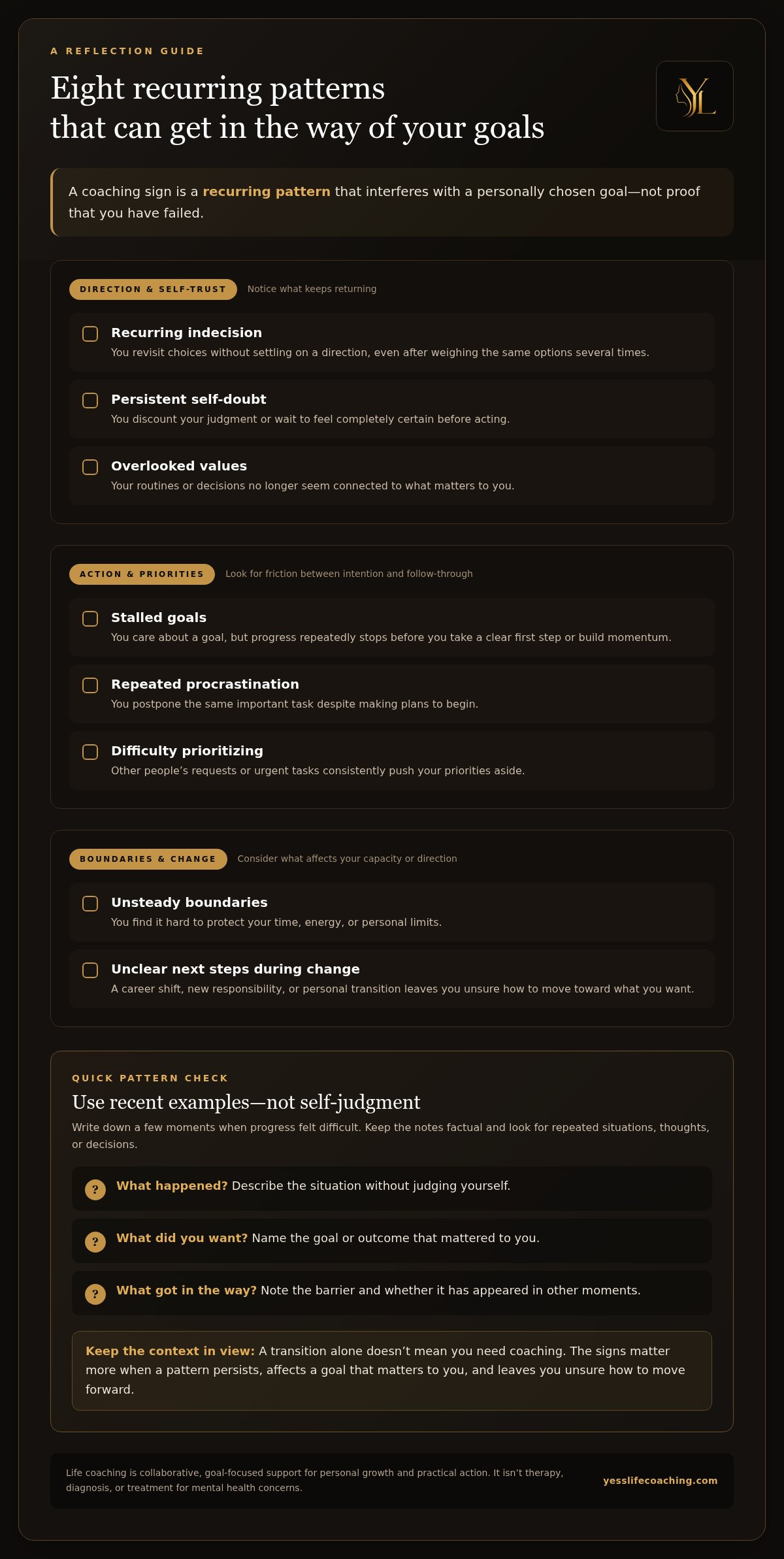
A coaching sign is a recurring pattern that interferes with a personally chosen goal. The Life coaching overview offers broader context for the practice. In everyday life, recurring patterns may include:
Recurring indecision: You revisit choices without settling on a direction, even after weighing the same options several times.
Stalled goals: You care about a goal, but progress repeatedly stops before you take a clear first step or build momentum.
Repeated procrastination: You postpone the same important task, despite making plans to begin.
Difficulty prioritizing: Other people’s requests or urgent tasks consistently push your priorities aside.
Persistent self-doubt: You discount your judgment or wait to feel completely certain before acting.
Overlooked values: Your routines or decisions no longer seem connected to what matters to you.
Unsteady boundaries: You find it hard to protect your time, energy, or personal limits.
Unclear next steps during change: A career shift, new responsibility, or personal transition leaves you unsure how to move toward what you want.
A transition alone doesn’t mean you need coaching. It may simply call for time and adjustment. These signs you need a life coach become more relevant when a pattern persists, affects a goal that matters to you, and leaves you unsure how to move forward.
When wanting change does not become consistent action
You might plan to explore a new career direction, update your résumé, or build a routine that supports your wellbeing, then repeatedly postpone the first step. One delay can happen for many reasons. A familiar cycle of planning, avoiding, and feeling disappointed may point to a need for clearer steps, more structure, or support with follow-through.
Make the pattern specific rather than scolding yourself. What task do you keep postponing? What usually happens just before you put it off? Naming the moment can help you see whether the next step is too large, unclear, or competing with another priority.
When your choices no longer feel connected to your priorities
You may feel pulled by family, colleagues, or other people’s expectations while struggling to name what you want. If you second-guess decisions after making them, it can become harder to feel ownership of your direction. Uncertainty or low confidence isn’t a diagnosis. It can be a signal to pause, clarify your priorities, and consider which choice feels aligned with them.
How to Tell Whether These Signs Are a Recurring Pattern
One hard day can make everything feel uncertain, but it doesn’t tell the whole story. Before deciding whether the signs you need a life coach apply to you, look at recent examples and consider what was happening around them. A demanding season, a major transition, or shifting responsibilities can temporarily disrupt routines without pointing to a lasting pattern.
A repeated obstacle is a familiar barrier that keeps interrupting a goal; a temporary setback may ease as circumstances change. There’s no clinical threshold to meet. Instead, notice whether the same friction returns, affects something you genuinely value, or leaves you unsure how to choose a next step. The U.S. Bureau of Labor Statistics offers a professional overview of how a professional life coach works with clients, which can help put coaching in context as you reflect.
Use a simple pattern check before drawing conclusions
Choose a few recent moments when progress felt difficult. Write down what happened, what you wanted, and what stopped your next action. Keep the notes factual. You’re looking for repeated situations, thoughts, or decisions, not evidence that something is wrong with your character.
What happened? Describe the situation without judging yourself.
What did you want? Name the goal or outcome that mattered to you.
What got in the way? Note the barrier and whether it has appeared in other moments.
Then ask: Does this pattern conflict with a goal I truly value? If yes, your notes can help you identify where clarity, structure, or support would be useful. If the goal no longer feels important, that matters too. You may want to revise it or choose a different direction.
Notice the difference between external demands and your own direction
A stalled goal may reflect limited time or competing responsibilities, not a lack of commitment. You might be trying to meet family needs, work demands, and personal expectations all at once. Before pushing harder, ask whether the goal is yours or whether you’re carrying it mainly to satisfy someone else.
Your answer can shape a practical next step. You might protect time for a personally meaningful goal, adjust it to fit your current capacity, or pause and choose a different direction. None of those choices is failure. If you’d value a collaborative space to clarify your priorities and plan intentional action, YESS Life Coaching offers personal-growth support for women.
Do These Signs Mean You Need a Life Coach, or Just a Hard Season?
No. Asking for support isn’t proof that you’ve failed or can’t manage your life. It can be a thoughtful way to move toward a goal with more clarity. A demanding week, a new caregiving responsibility, or an unexpected change at work may disrupt your usual routines. That’s different from repeatedly wanting to make a personally meaningful change, then feeling unable to choose or sustain a next step.
There’s no fixed test or timeline. Consider context and impact instead. If a new role leaves you temporarily unsure, you may need time to adjust. If you’ve returned to the same career question repeatedly and it keeps you from exploring options you value, a coach can help you think through your direction and identify practical next steps. The signs you need a life coach aren’t a verdict. They’re prompts to consider what kind of support fits your situation.
When coaching may fit the question you are asking
Life coaching can support personal development goals such as clarifying a direction, building confidence, or shaping an idea into an actionable plan. You bring the goals that matter to you; coaching offers a collaborative space to examine choices and plan intentional action. You can start with a specific question or goal rather than arriving with a complete plan.
For example, you might want to define what professional growth means to you, or create a realistic plan for a personal goal. The central questions are forward-looking: What do you want to work toward? What has made progress difficult? Which next step feels both useful and manageable?
When the need is outside life coaching’s scope
Coaching is non-clinical support for personal development. It isn’t therapy or psychotherapy, and it doesn’t diagnose or treat mental-health conditions. If your concern calls for clinical care, life coaching isn’t a substitute. These boundaries help you seek support suited to your needs.
Coaching also isn’t crisis or emergency intervention. If you or someone else is in immediate danger, contact local emergency services or go to an emergency department. You deserve timely support that fits the urgency of the situation. For non-urgent personal goals, take time to reflect on whether a collaborative coaching conversation feels like a grounded next step.
A Self-Assessment Checklist for Deciding What Support You Want
You don’t need to decide immediately whether coaching is right for you. Start by getting clear about what you want and what kind of help would feel useful. These questions can turn a broad feeling of being stuck into a more grounded choice.
Four questions to clarify what is keeping you stuck
What change matters to you now? Name a goal that feels meaningful to you, apart from what others expect you to want.
What tends to happen when you try to move toward it? Identify the recurring barrier, decision, or circumstance that interrupts your next step.
What would you like to change? Describe the progress you hope to see in your own words, whether that means greater clarity, steadier follow-through, or a different direction.
What kind of support would feel useful? Consider whether you want accountability, room to reflect, practical planning, or help exploring options.
Your answers don’t need to be polished. They’re a starting point for understanding which of the signs you need a life coach may reflect a goal you want to work on, and what support could serve it.
Choose a next step that feels manageable
Choose one small action that could give you useful information or help build momentum. You might set aside time to explore an option, write down a boundary you want to communicate, or break a large goal into a first task. Define what progress would look like for you, not by someone else’s standard.
Then give yourself permission to take your time. You can try a step on your own, adjust the goal, or continue reflecting before deciding whether coaching fits. For another perspective on support centered on women’s growth and goals, read empowerment life coaching for women.
If a collaborative conversation feels like the support you want, explore YESS Life Coaching. One-on-one and group coaching for women can help you clarify priorities and consider practical next steps, while the decisions about your direction remain yours.
How YESS Life Coaching Can Help You Move Forward With Intention
Recognizing the signs you need a life coach doesn’t mean you have to change everything at once. It can simply help you name where you want support. YESS Life Coaching offers one-on-one and group coaching for women, focused on personal growth, mindset, confidence, and actionable progress. The work starts with your chosen goals, not someone else’s definition of success.
Coaching is collaborative. You bring your questions and priorities; sessions create space to explore them and consider practical steps. It’s non-clinical personal-development support, not therapy or treatment, and it can’t promise a particular outcome. Your choices remain yours.
What coaching conversations can help you work on
The conversation can meet you where you are. If you’re caught in indecision, you can explore which priorities matter most and identify one next step. If a goal keeps stalling, you can break it into manageable actions and consider what kind of accountability would help you follow through. If confidence feels diminished, you can reflect on your strengths and practice making choices that feel more aligned with your values.
These aren’t shortcuts or instructions to follow blindly. They’re ways to focus on what you want, what’s getting in the way, and what you’re ready to try. One-on-one and group formats offer different settings for that work, with the focus on women’s growth and personally meaningful goals.
Take a gentle next step with YESS
You don’t need to arrive with a complete plan or perfectly worded goal. You can begin with a question, a recurring frustration, or a sense that you’re ready for a change but aren’t sure where to start. Coaching gives you a collaborative space to explore what matters and shape possible actions without taking ownership of your decisions away from you.
If a recurring pattern is affecting a goal you care about, YESS Life Coaching’s one-on-one and group coaching can support your personal growth with a focus on confidence, mindset, and actionable strategies. You can start by naming what you want to work on and the next step you hope to take.
Choose a Next Step That Honors Your Goals
The signs you need a life coach are worth considering when a recurring pattern keeps pulling you away from a goal that matters. One difficult day doesn’t define you, and recognizing a pattern isn’t a judgment. It’s a chance to reflect on what you value, what’s getting in the way, and what support might help.
Coaching can offer a collaborative space to build clarity and take intentional steps. YESS Life Coaching supports women through one-on-one and group coaching focused on personal growth, confidence, mindset, and actionable strategies. It’s non-clinical support, and your goals and choices remain your own.
If you’re ready to take a grounded next step, explore women’s life coaching with YESS. Bring the goal or recurring challenge you want to work on, and begin moving forward with intention.
Frequently Asked Questions
What are the most common signs you need a life coach?
Common signs include recurring indecision, goals that repeatedly stall, procrastination, and difficulty prioritizing what matters to you. You may also notice persistent self-doubt, trouble honoring personal boundaries, or choices that feel disconnected from your values. One difficult day doesn’t necessarily point to a pattern. Pay attention when the same obstacle keeps returning and interfering with a goal you genuinely want to pursue.
Can you benefit from a life coach if nothing is seriously wrong?
Yes. You don’t need to be in crisis or facing a major problem to value coaching. You might want to clarify a goal, strengthen your confidence, or turn an idea into practical steps. Life coaching focuses on personal development and goals you choose for yourself. Seeking support can be a deliberate investment in your growth, not evidence that something is wrong with you.
How do you know if you need a life coach or just need more time?
Consider the pattern and its context rather than relying on one difficult day. A new responsibility, heavy workload, or life transition may temporarily disrupt your routines, and time to adjust may be enough. If the same goal-related barrier keeps returning and leaves you unsure how to proceed, coaching may help you work through it. Note what happened, what you wanted, and what seemed to block your next step.
Is life coaching the same as therapy?
No. Life coaching is non-clinical support for personal development and chosen goals. It can help you clarify priorities, consider options, and plan actions. Therapy and psychotherapy address mental-health needs and may involve diagnosis or treatment. A life coach does not diagnose or treat mental-health conditions, and coaching isn’t a substitute for clinical care when that is what you need.
Can a life coach help if you feel stuck in your career or personal life?
A life coach can support you in clarifying what you want and identifying practical steps toward it. For example, you might explore what professional growth means to you, or work out how to make time for a personal goal. Coaching conversations can include reflection, confidence, mindset, and accountability. The work is collaborative and helps you consider options, without guaranteeing a specific result.
What should you prepare before talking with a life coach?
You don’t need a polished plan. It can help to bring a goal you’re considering, a recent example of what has made progress difficult, and a sense of what you hope might change. Think about whether you’d value reflection, accountability, practical planning, or help exploring options. Even a few honest notes can give the conversation a useful starting point.
When is life coaching not the right kind of support?
Life coaching isn’t the right support for diagnosing or treating mental-health conditions, and it doesn’t replace therapy or psychotherapy. It also isn’t crisis or emergency intervention. If you or someone else is in immediate danger, contact local emergency services. For personal-development goals, coaching may be relevant; for needs outside that scope, seek support suited to the situation.



Comments